
Summary
Fibre diversity matters because dietary fibres differ in how they behave in foods and in the body. Closing the fibre gap remains a priority, but fibre quantity alone does not explain an ingredient’s role. Solubility, viscosity and fermentability help characterise fibres in their behaviour in the GI tract and distinguish options such as chicory root fibres, barley beta-glucans and short-chain fructo-oligosaccharides. For food manufacturers, these ingredients offer practical routes to fibre enrichment with a ‘Plus’. This article explores how to select fibres for a clear nutritional purpose.
In this blog, you’ll discover:
- Why the fibre gap remains an important nutritional challenge
- How solubility, viscosity and fermentability distinguish dietary fibres
- How BENEO’s fibre solutions combine enrichment with different nutritional and formulation benefits
- Why choosing a range of fibres matters alongside increasing fibre intake
Mixing fibres to maximise benefits
Fibre is having a moment, with ‘fibremaxxing’ putting it firmly in the spotlight. Behind the trend lies a real nutritional need: most people still eat too little fibre. But what if getting enough fibre is only part of the story? What if choosing fibres with complementary digestive functions and health benefits matters too?
Why dietary fibre matters
From whole grains and pulses to fruits, vegetables, nuts and seeds, plant-based foods bring fibre to our everyday meals. Dietary fibre is added to food as well and comes with a beneficial physiological effect on human health. Its benefits go well beyond digestive health: depending on the fibre, it can support regularity and reduce caloric intake, help lower cholesterol and blood glucose responses, or improve mineral absorption.
Eating more fibre can make a real difference to long-term health. A major review by Reynolds and colleagues[1] observed: higher fibre intakes were associated with a lower risk of non-communicable diseases such as coronary heart disease or type 2 diabetes in observational research. Trials also found improvements in body weight, systolic blood pressure, and total cholesterol. Their findings may support eating 25–29 grams fibres a day or even more.
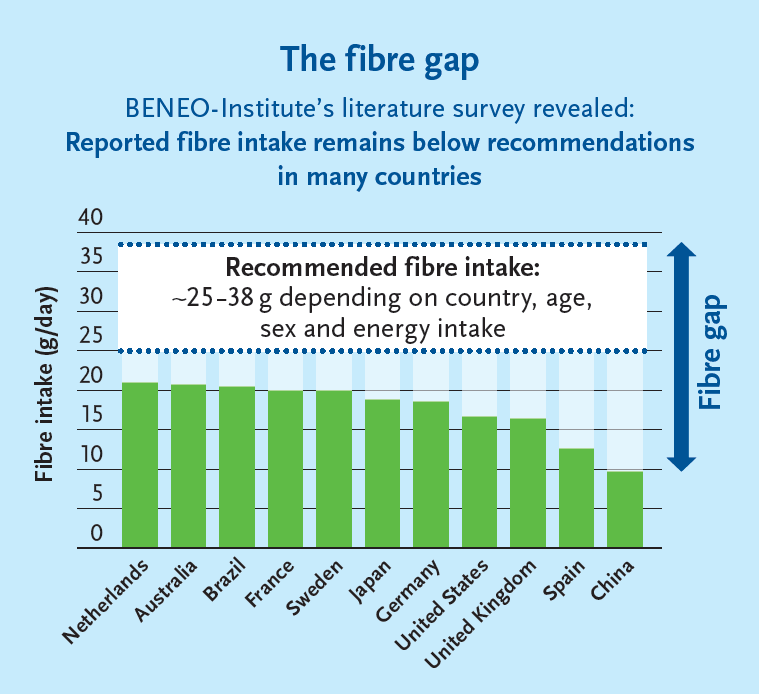
The message has long been simple: We need to eat more of it. And for good reasons. Yet a gap remains. Adult recommendations typically range from around 25 to 38 grams a day, depending on country, age, gender and energy intake. Reported fibre intakes in most countries fall short (Figure 1). Helping people close that fibre gap remains a priority.
Smart fibre enrichment – where it comes with a ‘PLUS’
Fibre-rich foods and recipes are a good place to start. Fibre enrichment of food products has a role to play, too, by bringing more fibre into foods consumers already enjoy. Fibre claims can help consumers identify these options.
Any fibre can contribute to increasing dietary fibre intake, while some fibre ingredient solutions can even bring additional value to foods. For instance,
- Some fibres can combine fibre enrichment with sugar replacement and calorie reduction, helping to improve the nutrient profile of foods.
- Whole grain flours offer a different ‘PLUS’: a natural blend of cereal fibres alongside other valuable nutrients.
- Fibre with established health benefits can help address specific nutritional goals. Examples range from bowel regularity with inulin to cholesterol management with beta-glucans . Related claims options depend on local regulations and conditions of use.[2] [3]
It all shows that fibre enrichment is not one single approach. And there is one important message more when it comes to selecting fibres for their relevance to human health: Not all fibres act in the same way. Different fibres have different health benefits.
Fibre diversity matters: Not all dietary fibres have the same health benefit
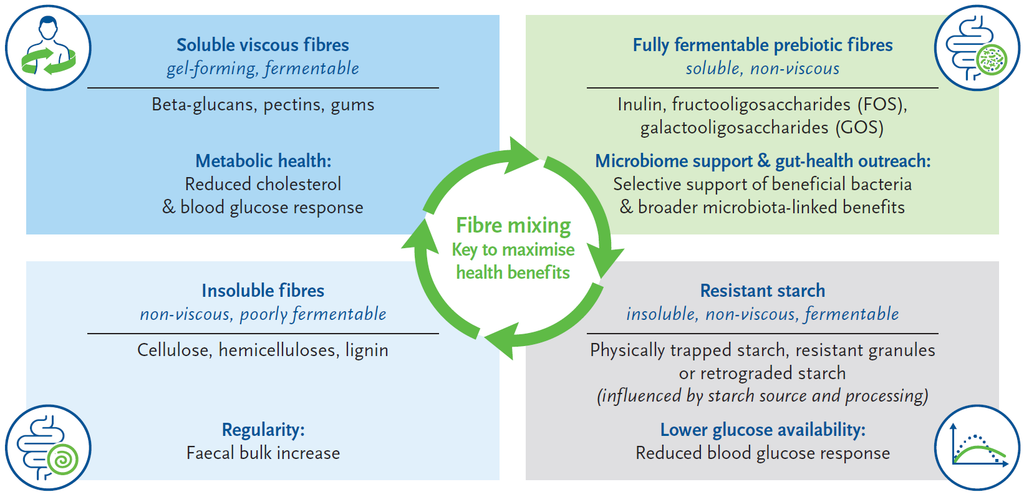
Dietary fibre covers a wide variety of non-digestible carbohydrate polymers. Their properties – in terms of solubility, viscosity and fermentability – shape how they behave in the body and determine which physiological functions and health benefits they can support (Figure 2). For example:
- Insoluble, poorly fermentable fibres such as cellulose can help support regularity by increasing faecal bulk.
- Resistant starch can help reduce glucose availability when replacing available starch.
- Soluble viscous fibres, such as cereal beta-glucans, can support metabolic health by lowering cholesterol and supporting blood glucose management.
- Prebiotic fibres, such as inulin and oligofructose, fulfil again another role: They nourish the gut microbiota, selectively support beneficial bacteria and so open the door to broader spectrum of microbiota-related health benefits.
This is where fibre diversity comes into play. Fibres contribute more than interchangeable grams: Choosing fibres with a wide range of properties and demonstrated benefits can broaden the nutritional value of a product. In other words: More fibre matters, but a powerful mix matters too.
BENEO’s fibre solutions in focus
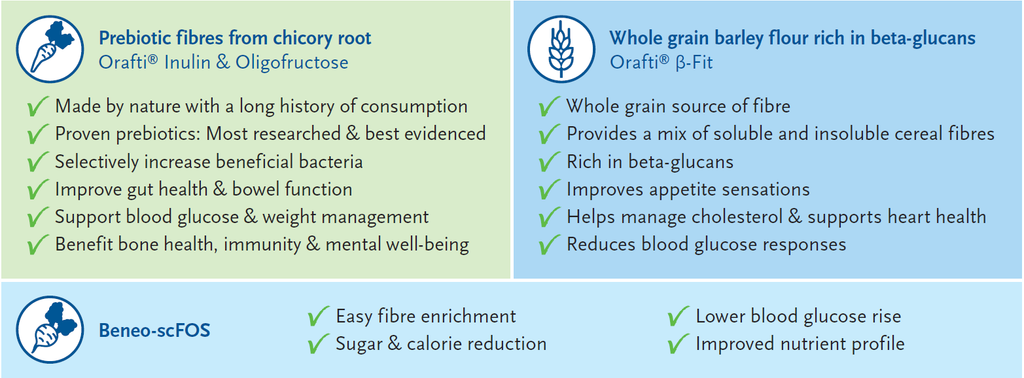
BENEO provides a versatile range of functional fibres from plant-based sources. Chicory root fibres, whole grain barley flour rich in beta-glucans (Orafti® β-Fit ) and Beneo-scFOS offer different solutions to enrich foods – and the PLUS of different benefits to build into formulations.
Prebiotic fibres from chicory root: Orafti® Inulin and Oligofructose
Naturally derived from chicory root, BENEO’s Orafti® Inulin and Oligofructose are proven prebiotics backed by decades of scientific research. Alongside their established role in selectively supporting beneficial bacteria, their benefits extend to gut health and bowel function, blood glucose and weight management, bone health, immunity and mental well-being.
The prebiotic credentials of chicory root fibres are an important distinction. Many fibres can be fermented in the gut, but fermentability alone does not make a fibre a prebiotic. According to the scientific consensus established by the International Scientific Association for Probiotics and Prebiotics[4], a prebiotic must be selectively utilised by host microorganisms and confer a health benefit. This is what distinguishes proven prebiotics such as chicory root fibres from fibres that are more generally fermented in the gut.
Taken together, its natural origin, selective nourishment of beneficial bacteria and scientifically demonstrated benefits make chicory root fibres the champion prebiotic and a strong choice for formulations with a proven prebiotic proposition.
Whole grain barley flour rich in beta-glucans: Orafti® β-Fit
While microbiome support is just one piece of the fibre-diversity puzzle, other fibres bring their own properties and benefits to the mix.
Orafti® β-Fit is a whole grain barley flour that naturally combines soluble and insoluble cereal fibres and is rich in beta-glucans. Its beta-glucans can help lower cholesterol, support heart health, and reduce blood glucose responses, when relevant intake conditions are met. Those benefits associated with barley beta-glucans become easily accessible with Orafti®β-Fit. And even more so, as a whole grain flour, Orafti®β-Fit allows to combine those established metabolic benefits with whole grain goodness. This makes Orafti® β-Fit a good example of fibre diversity within one natural ingredient -with whole grain positioning plus specific health benefits.
BeneoscFOS: Fibre enrichment with sugar replacement
Beneo-scFOS, a dietary fibre produced from beet sugar, offers an easy and affordable solution to increase fibre content in food. It can combine fibre enrichment with sugar replacement, helping to reduce sugar and calorie content, and so improve the overall nutrient profile of foods. It fits well with current health and nutrition policies for healthier food choices.
Its mild sweetness and high solubility make it suitable for a wide range of applications, helping develop products that deliver more fibre while meeting consumers’ expectations for taste and texture. Here, the PLUS is straightforward: fibre enrichment and sugar reduction in one ingredient solution.
Mixing and maxing the benefits
None of this changes the first priority: people need more fibre. But closing that gap does not have to mean focusing on quantity alone.
Combining fibres with different properties can allow manufacturers to bring together complementary nutritional benefits in their products. A fibre strategy could, for example, support straightforward fibre enrichment while also addressing sugar reduction, metabolic or heart health, or proven prebiotic benefits.
This is why fibre diversity deserves a bigger place in the fibre conversation. Instead of thinking about dietary fibre as one nutritional entity, we can recognise the different roles individual fibres can play and consider how mixing a variety of fibres can help maximise benefits.
Because when it comes to fibre, more matters. The right mix matters too.

Key takeaways
✅ Closing the fibre gap remains a priority; choosing different fibres adds another dimension to that goal.
✅ Fibre properties influence physiological roles, so dietary fibres are not interchangeable.
✅ Fibre enrichment can also address formulation goals such as sugar replacement.
✅ Chicory root fibres, barley beta-glucans and scFOS offer different options within BENEO’s fibre portfolio.
✅ A range of fibres can bring complementary functions into a product; the choice depends on the intended benefits and application.
References
[1] Reynolds et al (2019) Lancet 393:434–445. https://doi.org/10.1016/s0140-6736(18)31809-9
[2] Native chicory inulin — EU authorised claim: “Chicory inulin contributes to normal bowel function by increasing stool frequency”. The beneficial effect is obtained with a daily intake of 12 g chicory inulin. The claim applies to foods providing at least 12 g/day of native chicory inulin meeting the specification in Regulation (EU) 2015/2314: a non-fractionated mixture with monosaccharides below 10% and mean degree of polymerisation at least 9. Source: https://eur-lex.europa.eu/eli/reg/2015/2314/oj
[3] Barley beta-glucan — EU authorised claim: “Barley beta-glucan has been shown to lower/reduce blood cholesterol. High cholesterol is a risk factor in the development of coronary heart disease.” The beneficial effect is obtained with a daily intake of 3 g barley beta-glucan. Foods must provide at least 1 g barley beta-glucan per quantified portion. Source: Regulation (EU) No 1048/2012, https://eur-lex.europa.eu/eli/reg/2012/1048/oj
[4] Gibson et al (2017) Nat Rev Gastroenterol Hepatol 14(8):491–502. http://dx.doi.org/10.1038/nrgastro.2017.75
Further Reading
Nutrition Facts: The power of fibre diversity.
Blog: True Prebiotics Talk.
Blog: Sippable wellness: What makes a “prebiotic drink” actually prebiotic?
Video: Beneo sees prebiotics moving beyond gut health in ASPAC. Peen Ern Goh, Senior Manager Nutrition Communication Asia Pacific at BENEO, discussed how the conversation around prebiotics is expanding beyond gut health.
Webinar: The future of fibre starts with diversity. Follow this webinar to discover how fibre diversity can help maximise health benefits.
For healthcare professionals: Dietary fiber, a vital component of a balanced diet. Understanding the different types of fiber, their sources and health benefits to provide informed, tailored dietary advice.