
Summary
At the World Bakers Summit 2026, BENEO demonstrated how its ingredient solutions can help manufacturers develop future-ready bakery products. Practical examples from the BENEO-Technology Center showed how faba bean protein can replace eggs, how complementary plant proteins and chicory root fibre can improve nutritional profiles, and how tailored ingredient combinations can enhance gluten-free bakery applications. The key to success lies in combining ingredient functionality with application expertise to deliver products that meet both nutritional and sensory expectations.
Bakery products today must remain familiar and enjoyable while responding to growing consumer interest in protein, plant-based and gluten-free options and improved nutritional profiles. Sounds like a challenge – or like an opportunity for close collaboration between ingredient suppliers and bakery producers. In this article we explore how combining ingredient know-how, application expertise and industry dialogue can look like in practice.
In this blog, you’ll discover:
- How faba bean protein concentrate can replace eggs in bakery recipes while maintaining essential functional properties.
- How complementary plant proteins and chicory root fibre can help improve the nutritional profile of baked goods.
- How ingredient combinations can enhance the nutritional value, texture and eating quality of gluten-free bakery products.
- Why technical expertise and industry collaboration are essential for developing future-ready bakery solutions.
From the application lab to the speaker stage
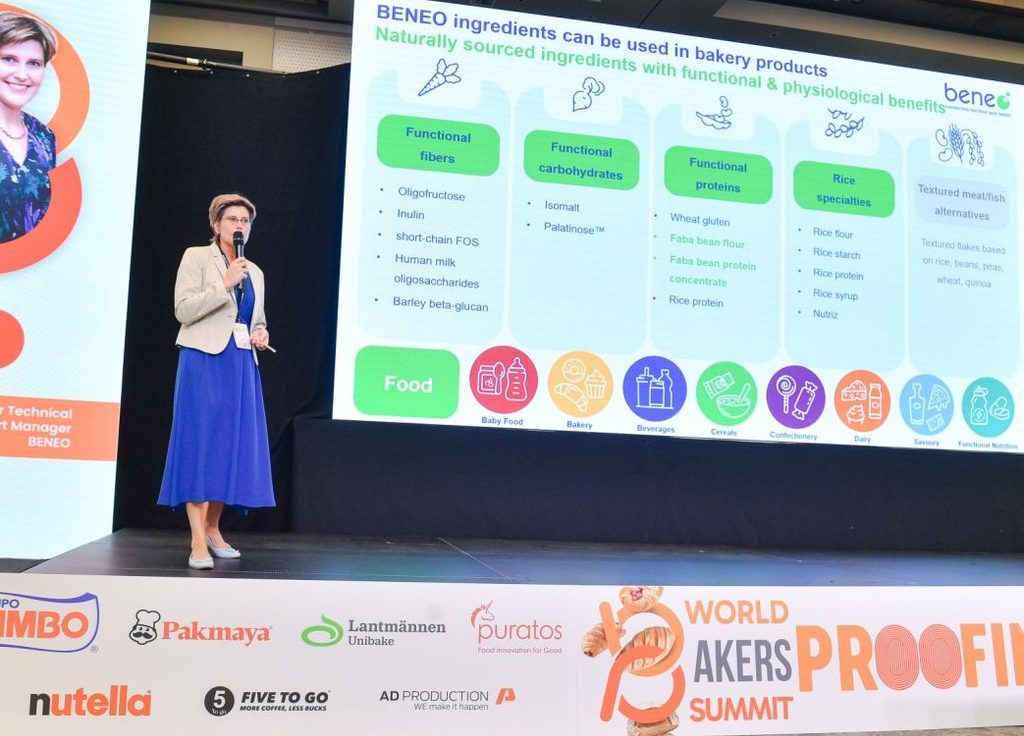
At the recent World Bakers Summit in Bucharest, from 15-17 September, Dr Isabel Trogh, Customer Technical Support Manager at BENEO, took the stage to inspire the bakery industry with faba bean ingredient solutions that are nutritionally relevant, technically workable and enjoyable for consumers at the same time. Let’s take a look at the insights she shared.
Egg replacement: Functionality and cost-effectiveness combined

In Europe, more than half of consumers are already buying or interested in plant-based bakery products, like muffins, cakes, biscuits or donuts.[i] This opens up huge innovation potential for the industry. Especially combined with the volatility of egg prices in recent years which put increasing cost pressure on bakery producers. But the key question is: how can eggs be replaced or reduced without losing its key functionalities?
The BENEO-Technology Center has shown through a range of recipe formulations and testing that BENEO’s faba bean protein concentrate is a cost-effective, high-performing, clean-label alternative that mimics the foaming, emulsifying, thickening and binding properties of eggs. Possible applications include muffins, meringue and biscuits.
In her speech in Bucharest, Isabel showcased this with two example recipes: a fully plant-based muffin and shortbread biscuit. In both formulations, all eggs are fully replaced by faba bean protein concentrate. The appearance, crumb structure of the muffin and firmness of the biscuit are similar to that of the reference products. The plant-based versions also offer a pleasant taste. As an additional benefit, both products offer the potential for reducing the recipe costs, depending on local raw material prices. That’s because the used dosage of protein concentrate is much lower than the amount of eggs in the reference recipes.
Riding the protein wave
Protein enrichment is moving into familiar everyday bakery formats. That’s no surprise as
- 57% of consumers globally say they are actively including more protein in their diet.[ii]
- Almost 6 in 10 consumers find a high in protein claim appealing in baked goods.[iii]
- 62% of consumers globally say they are extremely/very interested in plant proteins.[iv]
In her presentation, Isabel demonstrated how faba bean protein concentrate and vital wheat gluten can be combined for a delicious high protein brown bread recipe. The addition of BENEO’s chicory root fibre, Orafti® Inulin, even results in an additional high fibre claim, depending on local legislation. This improved nutritional profile leads to a better Nutri-Score rating, compared to a reference bread formulation.
Bakery producers looking not only for protein enrichment, but also a complete essential amino acids profile, can benefit from combinations of faba bean and rice proteins. These proteins complement each other in terms of their limiting essential amino acids. To go from theory to practice, Isabel shared a high protein biscuit recipe with her audience. It combines faba bean protein concentrate and rice protein, resulting in a high protein claim and a complete plant-based protein source. With a pleasant taste and texture, this biscuit is a better-for-you snack that allows to target health-conscious consumers.
Building better gluten-free experiences

One in three consumers globally find a gluten-free claim appealing in baked goods.[v] This opens up another space for product development in the bakery industry. 45% of consumers globally connect gluten-free with digestive health benefits[vi]. Digestive health has moved center stage over the past years. Bakery products in the gluten-free space can therefore gain a competitive edge. For instance, promoting fibre more prominently can help upgrade the health perception of gluten-free bread. However, taste continues to play a crucial role in attracting consumers to gluten-free foods.
The experts at the BENEO-Technology Center developed a gluten-free almond biscuit by using faba bean starch-rich flour. This ingredient is naturally rich in protein and fibre. That’s why its use allows for a biscuit with a source of fibre and source of protein claim, depending on local legislation. This indulgent snack can therefore convince consumers looking for that something extra. In the recipe, rice starch is added to optimise the texture and reduce breakage of biscuits. Using a higher amount of the faba bean starch-rich flour in a gluten-free pizza crust recipe even enables high in protein claims. Examples like this show how a smart combination of ingredients allows to combine improved nutritional properties with the taste and texture that consumers still expect.
Why technical exchange matters
The application examples highlight how the experts develop recipes in the BENEO-Technology Center food labs. Combining ingredient solutions, finetuning and ensuring appealing nutrition and health claim opportunities requires meticulous work. But the results don’t end up only in a recipe file. Attending events like the World Bakers Summit, as well as trade shows and conferences allows our application experts, what a lab cannot offer. “What I appreciate most about these events is sharing our knowledge and talking directly with representatives of the industry. Listening to their needs, inspiring them and exchanging ideas is where the true value lies”, Isabel shares. Presentations like hers can spark valuable discussions and exchange with bakery producers as well as equipment specialists. Future-ready bakery products need to meet the key consumer trends, while combining ingredient functionality, nutritional value, sensory quality and practical processing knowledge. This all requires ingredient suppliers and producers to work closely together.
Key takeaways
✅ Egg replacement creates new formulation opportunities.
Faba bean protein concentrate can replace eggs in selected bakery applications while delivering important functional properties and potential cost benefits.
✅ Protein enrichment benefits from complementary ingredients.
Combining faba bean protein with wheat or rice proteins can support high protein bakery concepts, while chicory root fibre offers additional opportunities for fibre enrichment.
✅ Gluten-free products can offer more than gluten avoidance.
Faba bean starch-rich flour and rice starch can help combine improved nutritional profiles with appealing texture and eating quality.
✅ Successful bakery innovation depends on application expertise.
Ingredient selection, formulation testing and close collaboration between suppliers and manufacturers are key to translating consumer trends into practical bakery solutions.

About Dr Isabel Trogh
As Customer Technical Support Manager at BENEO, Isabel Trogh is positioned as the bakery application specialist at the BENEO-Technology Center in Belgium, having joined the company in 2013. In this role, she is responsible for helping customers identify new opportunities using BENEO’s ingredients and providing solutions to technical challenges across all food applications. Alongside this, she develops technical documentation for all BENEO’s applications and ingredients, and delivers application training sessions and seminars for both internal and external stakeholders, as well as providing technical expertise.
With more than 20 years experience in the food industry, Isabel started her career as R&D Manager Patisserie Mixes, before moving to R&D Manager Nutrition and Product Manager Patisserie Mixes, all at Puratos Group in Belgium.
Isabel holds a Masters degree in Bio-engineer Chemistry (option food) and a Doctoral degree in Applied Biological Sciences, both achieved at the Catholic University of Leuven, Belgium.
References
[i] BENEO Global Plant-Based and Meat Hybrids Survey 2023 (N=6167)
[ii] Innova Trends Survey 2026
[iii] FMCG Gurus Bakery Survey 2026
[iv] HealthFocus International Global Trends Study 2026
[v] FMCG Gurus Bakery Survey 2026
[vi] FMCG Gurus Digestive Health Survey 2022 & 2024
Further reading
- How plant-based reformulation helps food manufacturers to save costs
- Uncovering the power of faba bean protein
- Rethinking eggs: How the shortage is driving smarter, plant-based reformulation
- One year of pulse power at BENEO